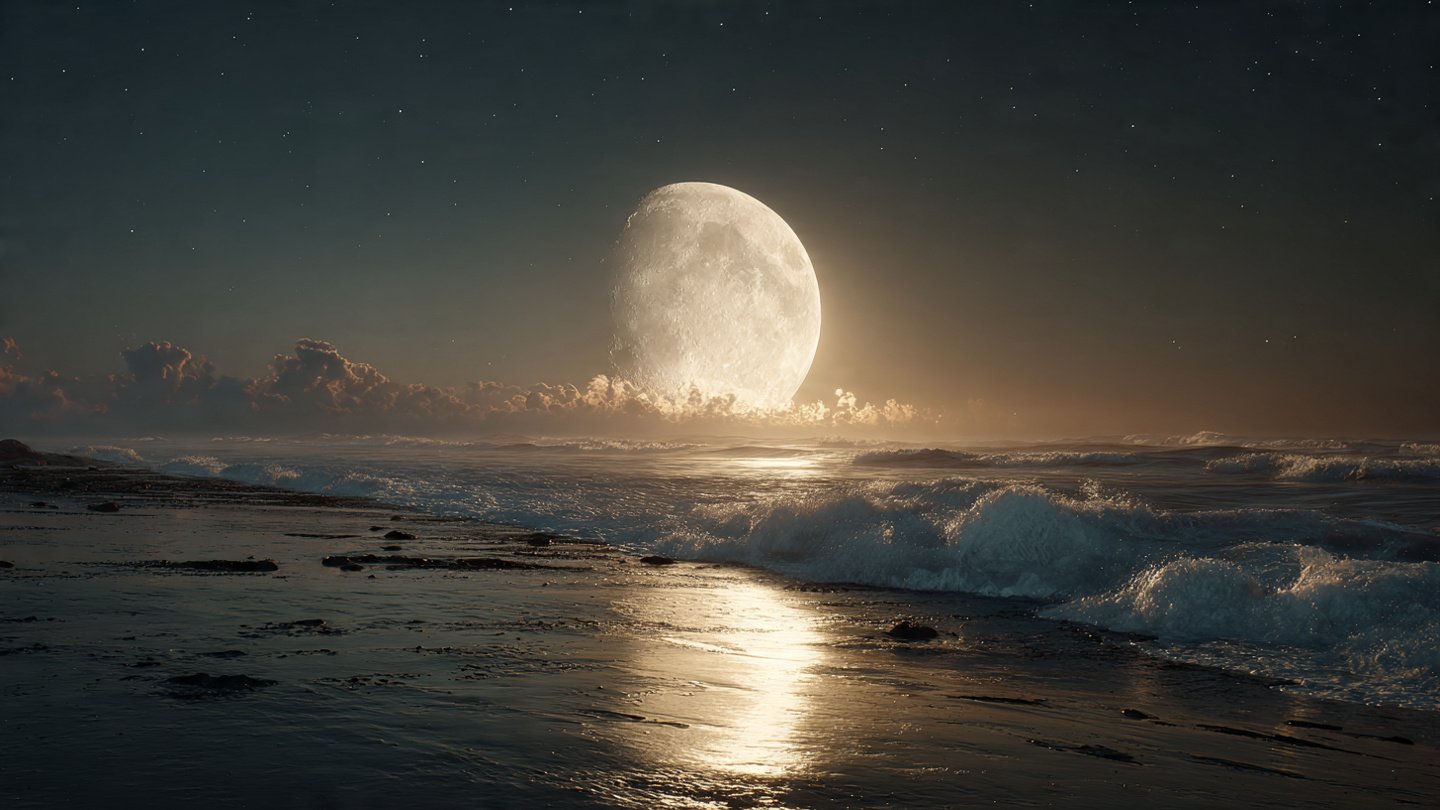
The Moon has been Earth’s silent companion for billions of years, shaping our planet in ways that are both subtle and profound. Its gentle tug affects the tides, stabilizes the planet’s rotation, and even influences the length of our days. But the Moon is not stationary—it is slowly drifting away from Earth. This gradual separation has consequences that unfold over vast timescales, subtly altering the rhythms of life, the cycles of the oceans, and the length of our days. Understanding this phenomenon reveals not only the interconnectedness of celestial bodies but also the delicate balance that sustains life on our planet.
The Moon’s Journey: Drifting Away from Earth
The Moon orbits Earth at an average distance of approximately 384,400 kilometers (238,855 miles). However, precise measurements using lunar laser ranging—bouncing lasers off reflectors left by Apollo astronauts—show that the Moon is receding at a rate of about 3.8 centimeters (1.5 inches) per year. While this may seem minuscule on a human timescale, over millions and billions of years, this slow drift accumulates significantly.
The primary cause of this recession is tidal interaction. As the Moon’s gravity pulls on Earth’s oceans, it creates tidal bulges. The Earth rotates faster than the Moon orbits, causing these bulges to slightly lead the Moon. The gravitational interaction between these bulges and the Moon transfers rotational energy from Earth to the Moon, causing Earth’s rotation to slow and the Moon to move slightly farther away.
How the Moon Influences Earth’s Days
One fascinating effect of the Moon’s presence is its role in regulating the length of our days. In the distant past, Earth rotated much faster, and a day lasted only about 18 hours. The Moon’s gravitational pull gradually slowed the planet’s spin, transferring angular momentum to itself. Today, a day lasts 24 hours, but this is not fixed. As the Moon continues to drift away, Earth’s rotation will keep slowing, lengthening our days by approximately 1.7 milliseconds per century.
Although imperceptible in everyday life, these changes accumulate over millions of years. In a billion years, our days could be an hour longer, subtly altering the natural rhythms that have influenced evolution and life cycles. Organisms that rely on circadian rhythms may need to adjust to these longer days, and even human society, from calendars to sleep patterns, is influenced by the length of a day.
The Moon and Tides: Nature’s Rhythmic Dance
The Moon’s gravitational pull drives the tides, creating a rhythmic rise and fall of the oceans. High tides occur where the Moon’s gravitational pull is strongest, while low tides occur in areas farther away. The Sun also plays a role, but the Moon is the dominant tidal force.
As the Moon drifts away, the tidal force it exerts on Earth decreases slightly. This leads to lower tidal ranges over geological timescales. Coastal ecosystems, such as mangroves, salt marshes, and tidal flats, are adapted to the current tidal ranges. Even slight changes could affect sediment transport, nutrient cycling, and the breeding cycles of marine organisms. While these effects are gradual, they demonstrate how interconnected Earth’s systems are with its celestial companion.
Geological and Oceanic Implications
The Moon’s slow retreat has implications beyond tides. Earth’s rotation affects the Coriolis effect, which influences ocean currents and wind patterns. Slower rotation could lead to subtle shifts in climate and ocean circulation. Over millions of years, these shifts could alter weather patterns, the distribution of heat across the globe, and even the development of ecosystems.
Additionally, tidal friction contributes to internal heating within the Earth. As tidal forces interact with the planet’s crust and mantle, they generate heat that drives geological processes like volcanism and tectonic movement. A weaker tidal force due to the Moon’s distance could influence these processes, although the effects would be extremely gradual.
The Moon’s Role in Stabilizing Earth’s Axis
One of the Moon’s most critical roles is stabilizing Earth’s axial tilt. Without the Moon, the tilt could vary wildly due to gravitational influences from other planets, leading to extreme climate fluctuations. The Moon’s gravitational pull keeps the tilt relatively stable at around 23.5 degrees, allowing seasonal patterns to remain consistent.
As the Moon moves farther away, its stabilizing effect will weaken. This could result in more pronounced fluctuations in Earth’s tilt over millions of years, affecting seasonal cycles and climate patterns. Such variations might influence the evolution of species and the distribution of habitats over geological timescales.
Impacts on Life and Evolution
The Moon’s influence on tides, rotation, and climate has played a role in shaping life on Earth. Many marine organisms rely on tidal cycles for reproduction, feeding, and migration. Changes in tidal intensity or timing could disrupt these behaviors. For example, certain fish and invertebrates spawn in sync with high tides, while intertidal species depend on predictable water levels for survival.
Longer days also impact the biological clocks of plants and animals. Circadian rhythms, which regulate sleep, feeding, and reproduction, are tuned to Earth’s rotation. Gradual changes in day length could create evolutionary pressures that drive adaptation over millions of years. While humans are unlikely to notice these changes on a generational scale, the cumulative effects over eons are profound.
Measuring the Moon’s Drift
Scientific understanding of the Moon’s movement relies on precise measurements. Lunar laser ranging experiments have been ongoing since the 1969 Apollo 11 mission, when astronauts placed reflectors on the Moon’s surface. By timing how long it takes for laser beams to travel to the Moon and back, scientists can measure its distance to millimeter precision.
These measurements confirm not only the Moon’s steady drift but also the rate at which Earth’s rotation is slowing. By combining these data with historical records, geological evidence, and computer models, researchers can predict future changes in Earth-Moon dynamics, helping us understand long-term planetary evolution.
Future Projections: Millions of Years Ahead
While the Moon’s drift is slow, its long-term consequences are significant. In hundreds of millions of years, Earth’s days could extend by several hours, and the Moon could be far enough away that tidal forces are weaker than today. If Earth’s rotation slows enough, tidal locking could occur, meaning one side of Earth would always face the Moon, though this is unlikely within the next several billion years.
For humanity, these changes are largely theoretical. The processes unfold over timescales far beyond a human lifetime. However, understanding them deepens our appreciation for Earth’s delicate balance and the role the Moon has played in shaping the environment that sustains life.
Cultural and Scientific Significance of the Moon
Beyond its physical influence, the Moon has been a constant presence in human culture. From mythology and folklore to calendars and navigation, the Moon has guided human activity for millennia. Its steady drift is a reminder that even seemingly permanent features of the night sky are dynamic, shaped by gravitational forces that govern the solar system.
The scientific study of the Moon’s movement also provides insights into planetary physics, celestial mechanics, and the history of the Earth-Moon system. By tracking these changes, we gain a better understanding of how planets and moons interact over billions of years, offering a glimpse into the long-term evolution of our solar system.
Conclusion
The Moon’s slow drift away from Earth is a subtle yet powerful process that touches every aspect of life, from the length of our days to the rhythm of the tides. Though the changes are imperceptible on a human scale, they accumulate over millions of years, influencing planetary rotation, climate patterns, ocean currents, and biological cycles.
By studying the Moon’s movement, scientists uncover the interconnectedness of celestial mechanics and Earth’s natural systems. The Moon is more than a glowing orb in the night sky; it is a guardian of stability, a driver of tides, and a regulator of time. As it continues its quiet journey outward, our understanding of its influence deepens, reminding us that even the slowest cosmic motions can have profound consequences over the eons.
In the end, the Moon drifting away is not just an astronomical curiosity—it is a testament to the intricate dance of gravity, time, and life itself. By observing and understanding these changes, we gain a richer appreciation of our planet’s past, present, and future in the vast cosmos.